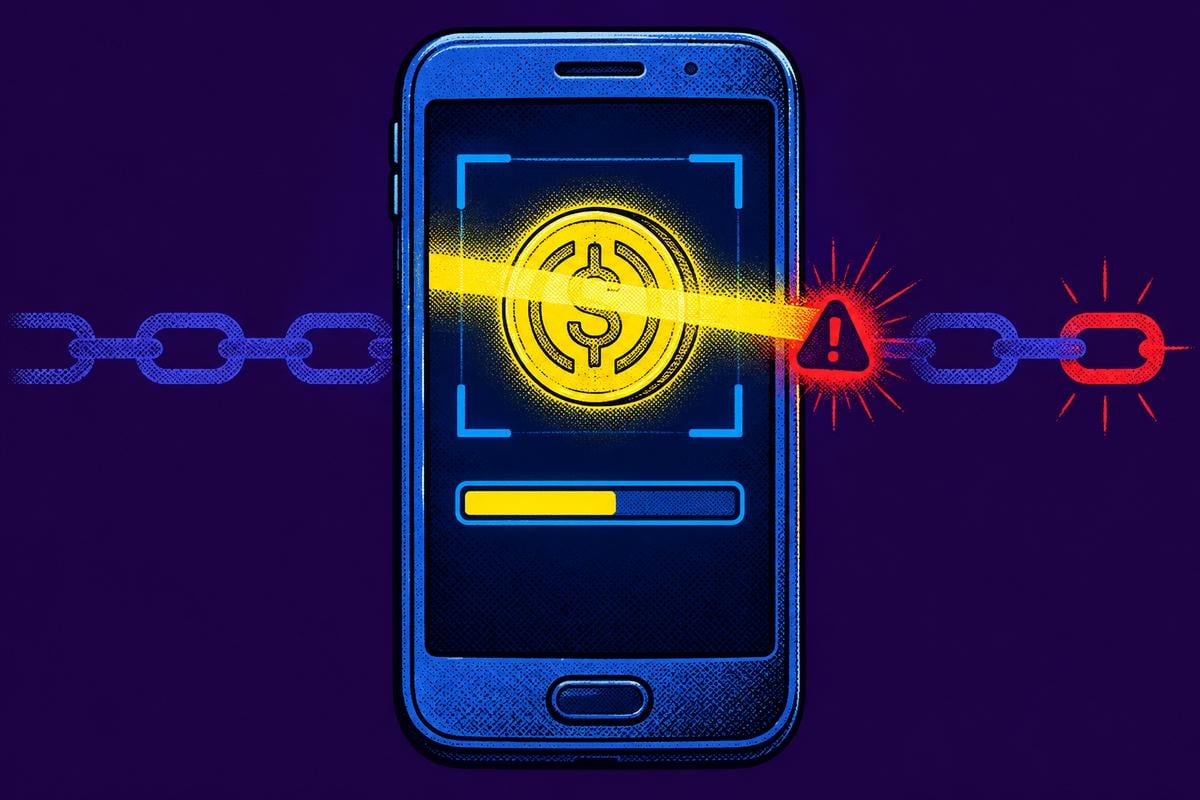
Mastercard is expanding its stablecoin risk screening with Stablecoin Security, a service introduced on October 19, 2026, that lets financial institutions assess payment risks before funds move onchain. Unveiled at Money20/20 USA, the tool checks for financial crime links and delivers risk scores through banks’ existing fraud and compliance systems.
Key takeaways
- Stablecoin Security screens payments for fraud, scams and sanctions risks.
- Borderless.xyz and Keyrails are the first integration partners.
- North America comes first, with global commercial availability expected in 2027.
How Mastercard’s stablecoin risk screening works
Stablecoin Security examines the origin of funds and the circumstances of a transaction before assigning a risk score. Mastercard said the service searches for potential connections to fraud, scams, sanctions violations and other financial crime throughout the stablecoin payment lifecycle.
Banks receive that intelligence through an API compatible with their existing fraud and compliance systems. The service gives financial institutions a way to assess a stablecoin payment before it completes.
“Stablecoins are creating new possibilities for value exchange, but financial institutions need the right intelligence and controls to participate with confidence,” said Ann Johnson, Mastercard’s executive vice president of Security Solutions.
First partners connect cross-border payment networks
Borderless.xyz and Keyrails are the first partners integrating Stablecoin Security. Their businesses span institutional access to stablecoin providers and high-value international trade payments.
According to Mastercard, Borderless.xyz connects financial institutions with licensed stablecoin providers in more than 113 countries and 72 currencies. Keyrails focuses on high-value cross-border trade payments, particularly in emerging markets. Both have participated in Mastercard’s Start Path Blockchain and Digital Assets program.
The Borderless.xyz partnership also includes a Crypto Credential pilot announced in August 2026. Infinia, Walapay and Koywe joined that initiative to add trust signals to cross-border stablecoin payments.
Mastercard’s stablecoin risk initiative follows its acquisition of infrastructure provider BVNK in August 2026. The deal followed an agreement announced in March 2026 worth up to $1.8 billion.
Last week, Mastercard launched its Global Money Platform in its first major BVNK integration. A single API is used to unify fiat and stablecoin accounts, real-time conversion, card spending and local bank payouts. Mastercard expects to incorporate BVNK into its Stablecoin Security plans in 2027.
Complex transfers form the backdrop to the rollout
A BIS study cited by Mastercard found that nearly 60% of stablecoin transfer events took place inside complex, multi-step transactions—not straightforward one-to-one payments. The research examined 593 million transfer events across 141 million Ethereum transactions in 2025.
Transaction context is one of the inputs Stablecoin Security uses before producing a score. Mastercard’s service will launch first in North America, with worldwide commercial availability expected in 2027.
Article produced with the assistance of artificial intelligence and reviewed by the editorial team.