
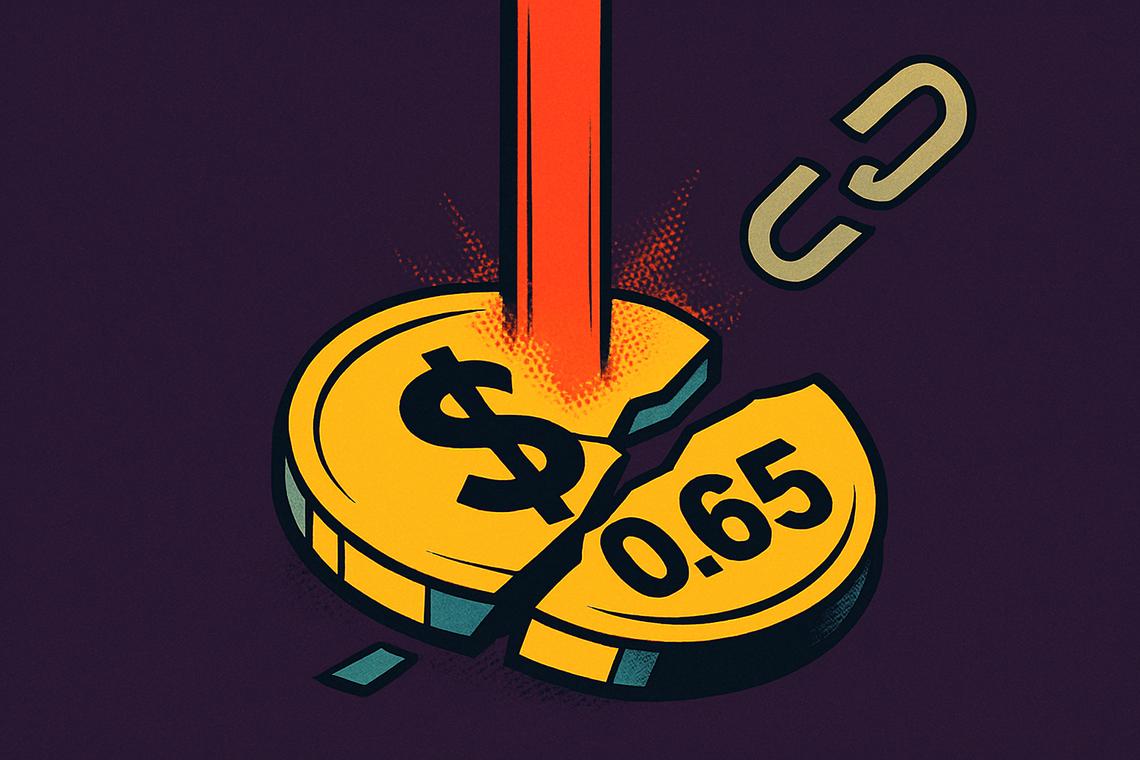
A flash crash on one of crypto’s biggest exchanges turned into a real-world stress test for a token that many traders assumed was rock solid. The USDe price drop on Binance during the October 10-11, 2025 market sell-off sent Ethena’s synthetic dollar as low as $0.65, even as the same asset barely moved a few clicks away on decentralized platforms. The gap between those two realities is now the real story here — not a broken stablecoin, but a broken venue.
Key takeaways
- USDe fell to about $0.65 on Binance and roughly $0.92 on Bybit during the October 10-11, 2025 sell-off, while Curve and Uniswap saw deviations under 0.3%.
- Binance’s thin internal orderbook and deposit/withdrawal issues blocked the arbitrage that normally keeps prices anchored to $1.
- Ethena Labs processed over $2 billion in redemptions within 24 hours, and USDe’s total supply exceeded $12 billion at the time, down from a peak near $14 billion tied to earlier Binance reward programs.
- An emergency Proof of Reserves report showed the protocol overcollateralized by about $66 million.
- The broader crypto market saw roughly $19 billion in liquidations during the same sell-off.
Sharp USDe Price Drop on Binance Amid Market Sell-Off
The clearest fact of this episode is simple: USDe traded at wildly different prices depending on where you looked. On Binance, the token cratered to roughly $0.65. On Bybit, it slid to approximately $0.92. Neither figure reflected what USDe was actually worth if redeemed through the protocol itself.
Price plummet specifics on Binance and Bybit
Both drops happened during the same broad market sell-off on October 10-11, 2025, a period when volatility spiked across crypto and liquidity thinned out fast on several centralized exchanges. Binance bore the brunt of the dislocation, with Bybit showing a smaller but still notable deviation.
Minimal price deviation on DeFi platforms
Meanwhile, decentralized venues told a completely different story. On Curve, USDe’s price deviation stayed under 0.3%. Uniswap and Fluid showed similar stability throughout the turmoil. That contrast — a near-35% drop on one exchange versus a fraction of a percent elsewhere — is what turned this into a talking point across the industry rather than just another volatile trading session.
Binance Operational and Liquidity Challenges as Cause
The dislocation traces back to Binance’s own market structure, not to any weakness in Ethena‘s underlying mechanism. A thin internal orderbook distorted the price signals feeding into oracle pricing, and that thinness became the crack everything else fell through.
Thin internal orderbook effect on pricing
When an orderbook lacks depth, even moderate sell pressure can push a price far from where it should sit. That is essentially what happened to USDe on Binance: a wave of selling met a book that couldn’t absorb it without a steep price concession.
Deposit and withdrawal issues blocking arbitrage
Normally, a gap like this gets closed fast. Arbitrage traders buy the cheap token on the distressed venue, move it elsewhere, redeem it at par, and pocket the spread — a mechanism that keeps prices honest across exchanges. This time, issues with deposits and withdrawals on Binance got in the way, preventing traders from doing exactly that. Ethena Labs and multiple traders pointed to Binance’s operational setup as the root cause of the dislocation.
Why this matters: when the arbitrage loop breaks, the price shown on a single exchange stops functioning as a reliable signal of an asset’s true value. That is a market microstructure problem, and it can happen to any token, not just USDe.
Ethena Protocol Performance and Token Economics During Incident
Away from Binance’s charts, Ethena’s own infrastructure kept running without interruption. The protocol’s mint and redeem functions processed more than $2 billion in redemptions within a 24-hour window during the incident — a volume that suggests the system absorbed real stress rather than freezing under it.
USDe total supply context and prior Binance reward impact
USDe’s total supply exceeded $12 billion at the time of the sell-off, having previously peaked near or above $14 billion. That earlier growth was driven largely by reward programs Binance had run that encouraged heavy accumulation of the token, which helps explain why so much USDe activity was concentrated on that specific exchange when the dislocation hit.
Proof of Reserves publication and overcollateralization
To reassure holders while the Binance price chart looked alarming, Ethena published an emergency Proof of Reserves report. It showed the protocol was overcollateralized by approximately $66 million — evidence, at least at that moment, that the backing behind USDe remained intact even as its Binance-quoted price told a very different story.
Wider Market Context and Impact on Holders
None of this happened in isolation. The same sell-off that hit USDe on Binance triggered approximately $19 billion in liquidations across the broader crypto market, according to the figures tied to this event. That scale of forced selling is exactly the kind of environment where thin orderbooks and stressed exchange infrastructure tend to produce outsized, isolated price swings.
Disparity between Binance price and protocol value
This is where the analytical core of the story sits. The price crash on Binance did not reflect the actual redeemable value of USDe — it reflected a temporary breakdown in that specific venue’s liquidity and operations. DeFi protocols that rely on oracle feeds aggregated from multiple sources were largely insulated from the shock, because no single distorted price point could dominate their pricing. Platforms leaning heavily on Binance’s own price data were far more exposed.
Losses for Binance holders from liquidations
That distinction mattered enormously for anyone caught on the wrong side of it. Holders who kept USDe on Binance and got liquidated during the flash crash suffered very real, permanent losses — even though the protocol backing their tokens never actually stopped functioning normally. In practice, the venue you used to hold or trade USDe determined whether you experienced a brief anomaly or a costly liquidation.
FAQ
Why did Ethena’s USDe token price drop sharply on Binance?
The sharp price drop on Binance was caused by a thin internal orderbook and operational issues with deposits and withdrawals that blocked arbitrage opportunities.
Did the price drop on Binance indicate a failure of the Ethena protocol?
No, the Ethena protocol continued its mint and redeem functions smoothly, processed over $2 billion in redemptions, and remained overcollateralized.
How did USDe’s price behave on decentralized exchanges during this sell-off?
USDe’s price on DeFi platforms like Curve and Uniswap stayed stable with deviations under 0.3% despite market turmoil.
What was the broader market context during the USDe price incident on Binance?
The incident occurred during a wide crypto market sell-off that caused about $19 billion in liquidations across the market.
Article produced with the assistance of artificial intelligence and reviewed by the editorial team.